Almira, Madison and Calvin
The experiences of black Americans after the Civil war were inconsistent and varied. This is, in great part because the American experience itself was erratic. The transition from three hundred years of enslavement to freedom was perhaps the most chaotic transition in the history of our country. No one knew how freedom was going to work. Books and movies depict freedom in a very singular one dimensional perspective, much in the same way slavery is depicted. History, especially complicated history is never one dimensional. Freedom wasn’t only about big life choices. It was about very personal things like choosing who you have children with, raising those children and choosing where you live your life: simple human choices. For the formerly enslaved, their bodies, choices and futures were for the first time their own.
This is so perfectly illustrated in the experience of three of Dick and Anna’s eleven children: Almira, Madison and Calvin. They all met freedom with a shared history but also with individual personalities and circumstances. And the choices they freely made were equally as unique. These choices impacted their children and even their grandchildren. That’s how the symphony moves and changes. They all started out in the same movement, but the tempo changed for each one as the movements progressed.
It is important to note that although slavery and geographic distance often separated Dick and Anna and their children, all evidence leads us to see they had a loving and close family. While enslaved they attended each others’ weddings, visited each other when they were living apart and when freedom came many of their children lived within close proximity to each other.
Almira was one of Dick and Anna’s oldest children. Her story is for the most part silent. As loud and vibrant as her brothers and sisters stories were, hers was quiet. Almira’s is the story anticipated when researching black family history. Researchers expect to reach that moment where the narrative fades. So we grasp on to the details we know and build upon those for the next generation. Almira was born in Person County, NC about 1825. She was removed to Tennessee when she was still a child with her family. We know that Almira was in Giles County in the early 1850’s because she attended her sister Harriet’s wedding in 1854. However, it is quite likely that Almira was being moved throughout farms and businesses to wherever William McKissack, her owner, needed her to be. Almira was a weaver. Court documents mention that she wove cloth for white women in Spring Hill. Logically this wasn’t the only labor she was doing, but she was known for and mentioned for her weaving. When William McKissack died Almira and her twelve-year-old daughter, Anna, were drawn by his daughter,Eleanor McKissack, and her husband, who lived in Maury County.
When Freedom came Almira continued to live close to not only the white people she had labored for, but also to the community she knew. She was within a few households of Eleanor McKissack, her former owner, but also living next to her brother Calvin and his family and her sister Malinda and her family. Freedpeople often had few opportunities for mobility, especially in the immediate aftermath of the war. It is impossible to know if Almira stayed put because she didn’t have the opportunity to leave, if she wasn’t physically able to leave or if she just felt comfortable with what she knew. As a single black woman entering freedom, staying where you were and having the built in support system of a family to help you and a familiar family to labor for would have given her no small measure of security.
In 1870 Almira’s household consisted of herself, her daughter Anna and her granddaughters Ella and Hattie. None of the family was listed as having an occupation outside of “house keeping.” It is interesting to note that Ella, who was eight-years-old was not attending school. Completely adverse to this, Almira’s siblings’ children all went to school and many of them were also college educated, even the ladies. This census was the only post war document with any information on Almira. She had most likely died before the 1880 US Census was enumerated.
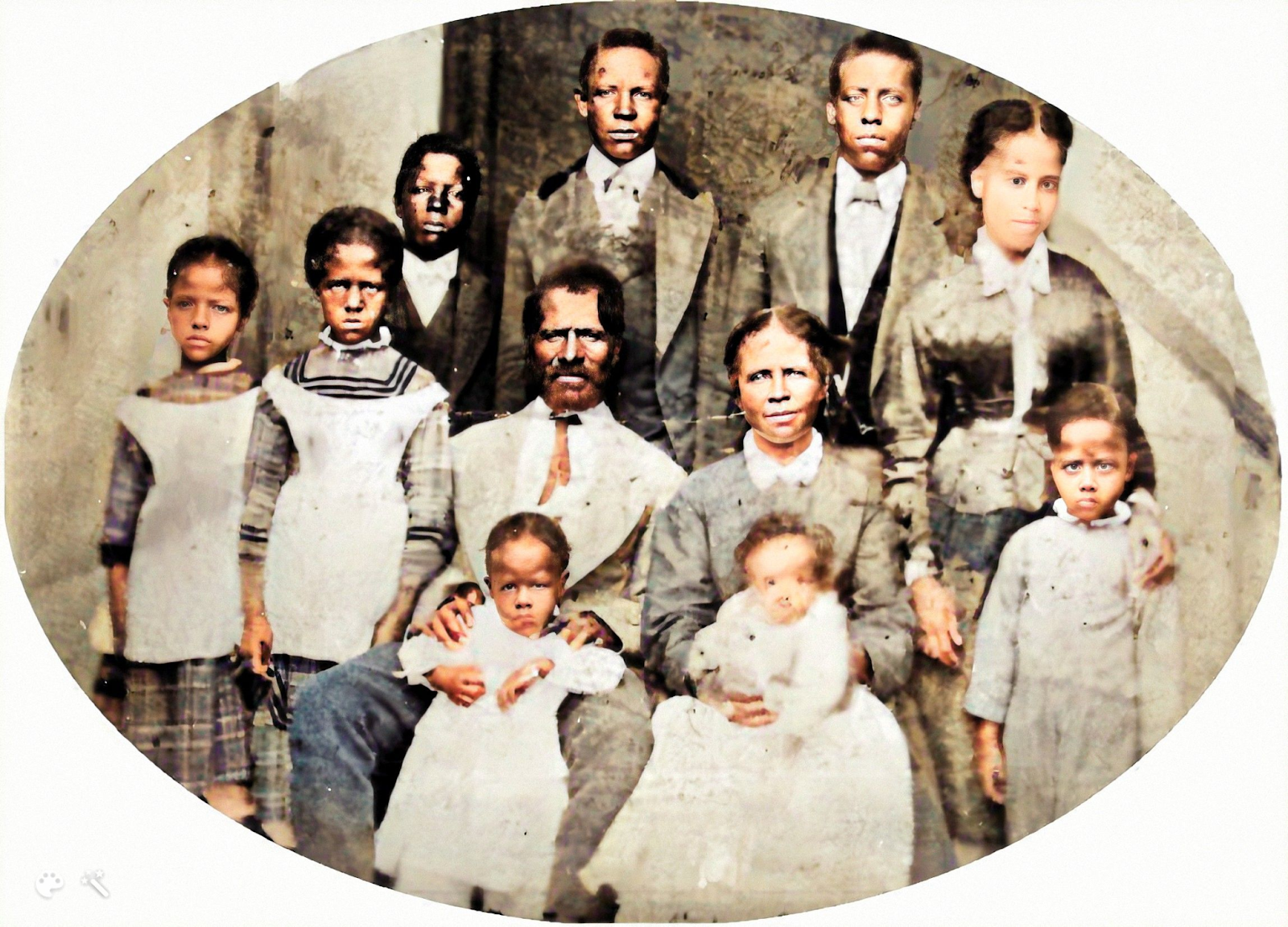
Madison and Caroline McKissack surrounded by their nine children.
Madison McKissack, a couple years younger than Almira, was a skilled brick mason. In 1850 Madison was loaned to Susan and Nat Cheairs to help plaster their home, Rippa Villa. Logic dictates he married Caroline at this time. Caroline was a young enslaved woman, who had been given as a gift from William McKissack to his daughter Susan when she was a little girl. Madison and Caroline’s first child, Lex, was born in 1852. When William McKissack died, Madison was drawn by, Jessie McKissack Peters. The Peters’ sent Madison to Arkansas, most likely after Jessie was married in 1858. Her husband owned a large cotton plantation in Phillips County. We do not know the exact nature of his labors. Madison said he “was sent to Arkansas to work for a couple of years.” Caroline remained at Rippa Villa, where Dick and Anna were also living.
When freedom came, Madison and Caroline met freedom with light skin and for Madison, a very distinct skill. This would have given him an incredible amount of social mobility. Caroline, unlike many freedwomen, was able to stay in the home and raise her children. For most freedwomen, they had to work to help bring in income to support the family. Caroline was among the first black mothers who got to create and maintain nurturing homes for their families. Initially after the war the family used the surname “Peters,” most likely because that was Madison’s last owners name. In February of 1867, Madison Peters purchased a lot in Spring Hill, TN. By the enumeration of the 1870 census he had reverted to using the name Madison McKissack, and still on other later documents, Madison Peters McKissack. Madison and Caroline had a small farm and raised nine children, all of their known children reaching maturity. Their oldest son, Lex, became a teaching assistant for the Freedman’s Bureau school in Spring Hill and most of their children attended college. The education of their children was obviously a high priority for them. In 1891, Madison was listed as a registered voter in Maury County, along with his son Madison Jr. Seeing their names listed together in the voter registration book is powerful. The “idea” of freedom had become a reality in Madison’s lifetime. He could own land. He could educate his children. He could vote. And all of these rights were being passed on to the next generation.
Calvin was Anna and Dick’s youngest child. He was only sixteen in 1856 when he was separated from his parents. Calvin was drawn by Eleanor McKissack, along with his sister Almira. Calvin was a carpenter and married Eliza Lee in Maury County after the war. There are multiple reports in late 19th Century newspapers that Calvin was an old soldier, although no contemporary military records can be found at this time to corroborate this. In the 1870’s the opportunities for freedmen and their families were few in Maury County, even for a skilled carpenter. Calvin worked hard and he co-purchased land and a mill with another freedman. However, Maury County in the 1870’s was not a safe place for people of color. The KKK was terrifyingly active. They threatened anyone they viewed as a threat, this included school children.
The violence of the 1870’s motivated a movement out of the south and onward to western states, known today as the Exoduster Movement. Families, like Calvin and Eliza’s, who moved West, did so to have a better and safer future for their children. They had a home and a business in Maury County, but they picked all of that up and moved thousands of miles to Lawrence, KS just for the hope of a better future. Calvin and his wife were brave. They flourished in Kansas. Calvin bought land and worked hard and succeeded. He never learned to read and write, but his children did. He was a mason and a republican. He was a delegate at multiple Republican conventions in Douglas County. He was active until he died of dropsy in 1898.
If you looked at Almira, Madison and Calvin’s stories independently, you might not know they had the same beginning. During slavery their lives were very similar: enslaved children of enslaved parents. They all met freedom, but they each embraced it differently. Freedom, like history, is not one dimensional. Each of their free choices lead them on a different journey. For Almira, freedom was choosing to stay. For Madison, freedom was education. For Calvin, freedom was choosing to move thousands of miles away. Freedom was vibrant. It was real. And it was theirs.
(Their choices impacted the next generation. See you next week.)
 Finding Josie
Beautiful story, beautifully written. Thanks Kristie for your grit and determination to get to the heart of the matter or better yet story🥰
LikeLiked by 1 person
I love this, and it’s so important to note: “Books and movies depict freedom in a very singular one dimensional perspective, much in the same way slavery is depicted. History, especially complicated history is never one dimensional.”
LikeLiked by 1 person