I love History and I always have as far back as I can remember. But I completely understand why some people don’t. History is an easy subject to make monotonous with places, dates and numbers…and SO much memorization. Unfortunately, that is overwhelmingly the way History is presented in our educational system: “The Battle of Franklin was on November 30, 1864. There were 10,000 casualties. It was a U.S. victory.” The human story is removed.
I am a family historian. I study people and how they fit into those places, dates and numbers. When you look at an individual, or a group of individuals and you learn their human story and how their experience fits into the collective narrative of our human journey. Goodness! It’s captivating! I am constantly learning more human stories and teaching and connecting both children and adults to History in what I hope is a memorable way. Being able to help people feel a tangible connection to their history is a powerful responsibility.
A few years ago I had an idea for a research project. We all know I love the symphony of History. It is an analogy I never get tired of using (although my co-workers DEFINITELY get tired of it!;) I thought “how wonderful would it be to connect musicians to the Battle of Franklin?” Not Civil War musicians, but modern day musicians that everyone knows. Use faces and voices we all recognize to cleverly illustrate the symphony by connecting them to soldiers who fought for their lives on the ground I walk every day. What made it even more compelling for me was Franklin is so close to Nashville, which is known as “Music City.” It felt right.
The first musician I randomly chose was Waylon Jennings. AND I found a BOF ancestor within about an hour! My head exploded with over confidence in my abilities and thoughts of “dahhhmmmmm, I’m good.” So I went on to another musician, and then another, and then another…for months and months, finding no connections. I probably know more about some musicians’ family histories than they do. That could sound creepy, but I promise I use my scrappy detective skills for good, not evil. From Jelly Roll to Loretta Lyn, I persevered. Eventually a few more BOF ancestors found their way onto my screen and my hope to build a battlefield with musician descendants became a possibility.
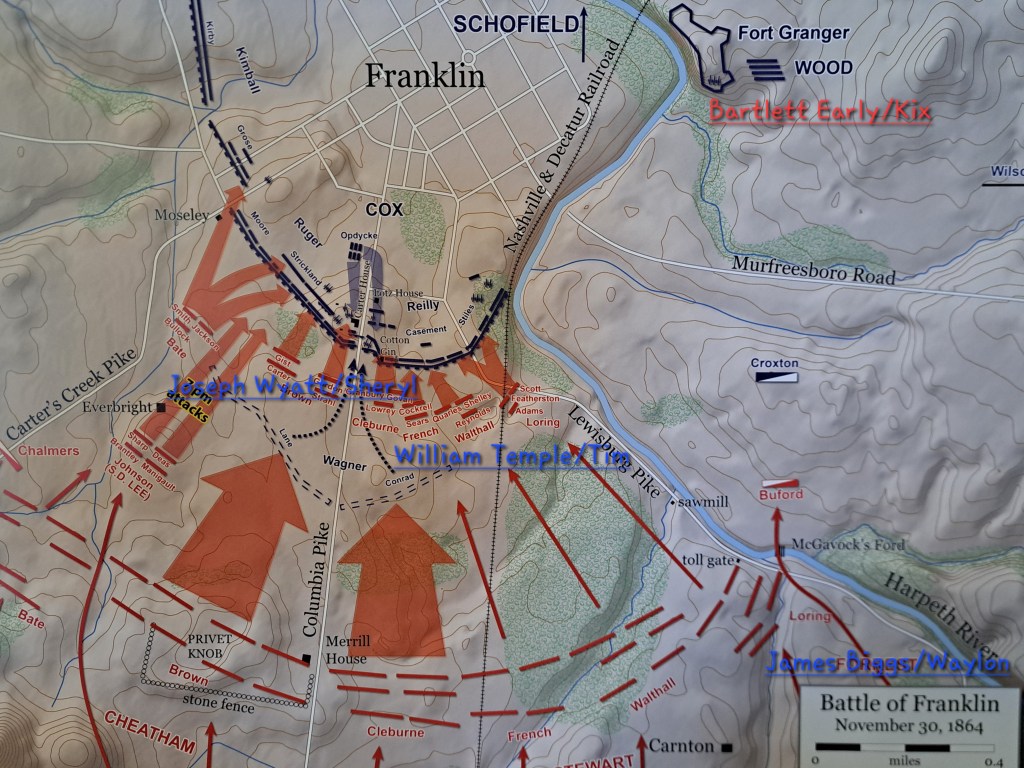
Bartlett Early was a sixteen-year-old boy who enlisted in 1864. At the time he enlisted he knew what was at stake. He was a baby, brave but too young to understand the horrors of war. He would have learned very quickly on the Atlanta Campaign. Bart, mustered into Co. B 19th OH Infantry, U.S. Army. Early, along with his regiment were among the first to arrive in Franklin the morning of November 30th. As soon as the railroad bridge was passable, they evacuated across the river. His division, commanded by Brig. Gen. Thomas Wood, guarded the evacuation of the U.S. soldiers from Franklin after the battle. When the army was safely on the north side of the river Wood’s men set fire to the bridges and made sure they were impassable before proceeding to Nashville. Bartlett Early’s great-great grandson is Kix Brooks.
According to his wife’s pension application, James Biggs served in various regiments throughout the war. For the first year, he served in Co. B 3 MS Infantry, then was transferred to the 18th MS Cavalry. Comrade J.K. McClure said James served throughout the war with him. He was forty-three years old with a family when he enlisted. His regiment, under the command of Gen. Nathan Bedford Forrest crossed the Harpeth River about 3pm on the 30th. They briefly skirmished with Wilson’s U.S. Cavalry before being repulsed and pushed back across the river with the rest of Forrest’s command. Biggs surrendered on May 4, 1865 in Citronelle, AL. His great-great grandson was Waylon Jennings.
Martha Wyatt sent five sons off to war. Joseph Wyatt was twenty-one years old when he enlisted in the Confederate Army. His brother was a captain of their regiment, the 12th TN Infantry, and the newspaper noted about he and his men “The black republican forces that encounter these Obion boys will rue the day they do..” The hail storm they faced the day of the Battle of Franklin was devastating. When Wyatt’s brigade was about 100 paces from the main line, the U.S. Army opened fire. His brigade commander General Gordon said “when the enemy opened fire it was as if Hell itself had exploded in our faces.” Gordon’s men broke through the main and secondary U.S. positions charging into the yard at the Carter House, where a vicious hand to hand fighting took place. They were pushed back by U.S. forces and took up position on the south side of the U.S. entrenchment. Wyatt fortunately survived the brutal fighting. His great-great granddaughter is Sheryl Crow.
A year into the war, William Temple enlisted in the Confederate Army, his regiment eventually becoming the 37th MS Infantry. His regiment was a part of Gen. Walthall’s division. They advanced across John McGavock’s farm, while the U.S. Army dumped more than 1,100 rounds of artillery around them. One U.S. soldier said he “…never saw the rebs fight better than they did at Franklin, nor get whipped worse. They fought with a desperation worthy of a better cause.” The desperation in the fields around Carnton was intense. Temple survived the Battle of Franklin, but was captured two weeks later at the Battle of Nashville. He spent the rest of the war in prison at Camp Douglas. His great-great-great grandson is Tim McGraw.
Some people do not understand why this project means so much to me and why it continues to hold my interest. After all, these musicians weren’t here. So why does it matter? For me, these stories illustrate the enduring humanity in history, the flawless choreography of the symphony. The Battle of Franklin had 10,000 casualties. Soldiers and their families were forever impacted. Some of those soldiers were casualties left on the battlefield, buried in graves and their descendants never became a reality. Thousands of human stories never to be born. For the men who survived and made it home. They had a different journey: a journey of survival, of healing and rebuilding. The people who descend from them, they are the result of that survival. A beautiful example of a perfect symphony. They contribute to our collective narrative, literally in vibrant melodious notes.
For me personally, I remember all those childhood evenings my brother and I watched the Dukes of Hazzard. I can still hear the introductory song. Waylon singing “just good ole boys” while his hands strummed the guitar, as I sang along, as loudly and off key as six-year-olds do. This memory is only possible because James Biggs survived the Battle of Franklin. That, my friends, is the simple beauty of a human connection.
Merry Christmas. :)K


You are amazing!!!
LikeLike
Love this, that was actually really cool. What does this mean, “The black republican forces that encounter these Obion boys will rue the day they do..”
Stephanie
LikeLike
Thanks for reading! “The black republican forces” is referencing the US Army, and the journalist is trying to incite public opinion that the US Army is ruled by Republicans who wanted to free slaves.
LikeLiked by 1 person
What a fun read!
LikeLike
As usual, another great article! Keep them coming!
Thank you for sharing!
LikeLike